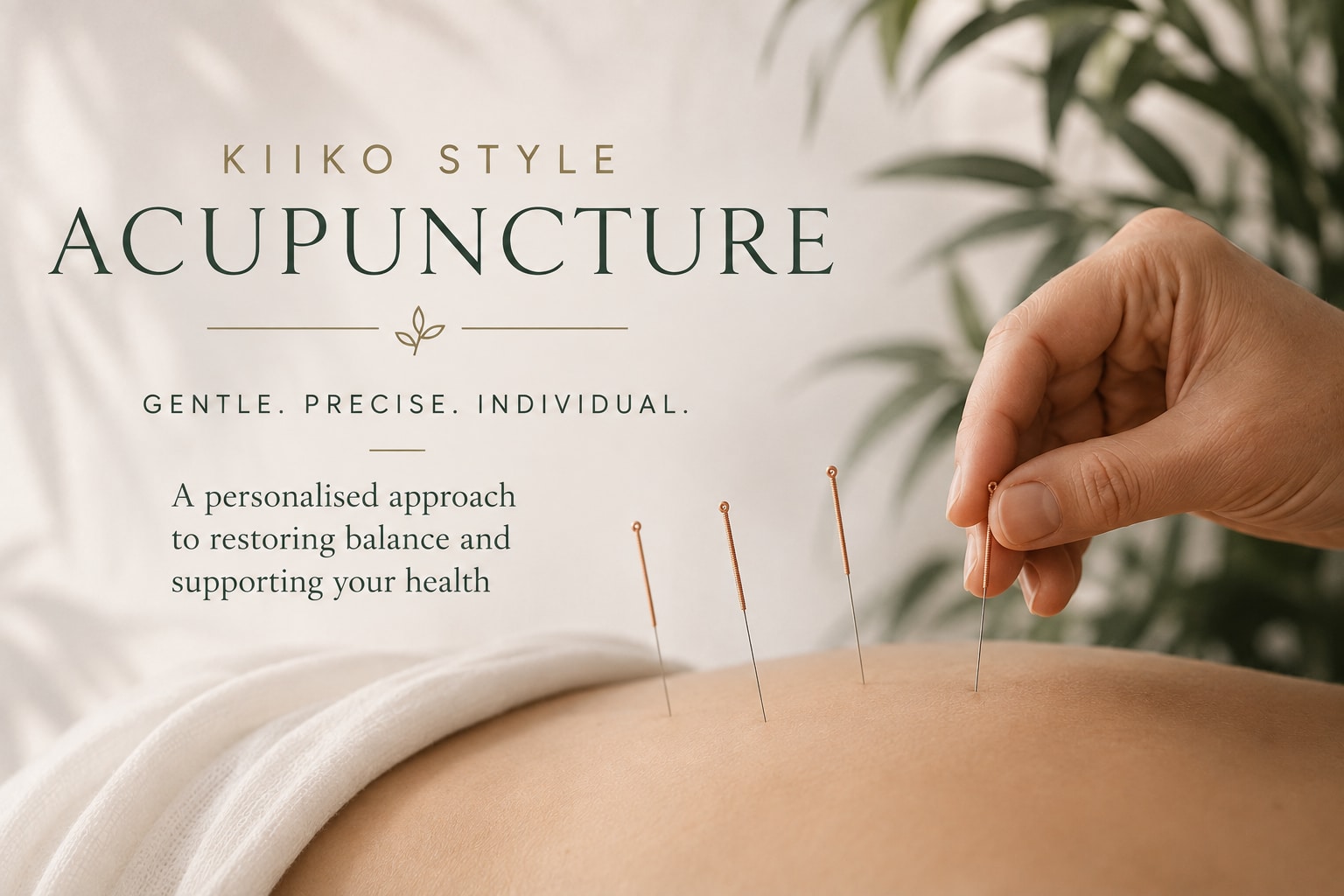
When looking for acupuncture Gold Coast patients have access to a range of different acupuncture styles and treatment approaches. At Haynes Acupuncture, we use Kiiko Style Acupuncture, a Japanese acupuncture system known for its gentle needling, detailed palpation-based diagnosis and highly individualised treatment approach.
Kiiko Style Acupuncture can be particularly useful when symptoms are complex, longstanding or difficult to explain through a single diagnosis. Rather than simply treating the location of a symptom, the treatment looks at how different systems of the body may be contributing to the patient’s overall presentation.
What Is Kiiko Style Acupuncture?
Kiiko Style Acupuncture was developed by Japanese-American acupuncturist Kiiko Matsumoto. It combines traditional East Asian medicine with Japanese acupuncture techniques and places a strong emphasis on palpation as a diagnostic tool.
One of the distinguishing features of this approach is that the practitioner doesn’t rely solely on a patient’s symptoms, tongue and pulse.
Instead, different areas of the body are palpated during the consultation. This can include the abdomen, neck, back, limbs and other diagnostic areas.
The practitioner is looking for changes such as:
- Tenderness
- Muscle tension
- Areas of hardness or tightness
- Sensitivity
- Changes in tissue quality
- Differences between the left and right sides of the body
- Changes that occur after a particular acupuncture point is stimulated
This makes the treatment process highly interactive. A point may be selected because it corresponds with a particular diagnostic pattern, but the practitioner can then immediately reassess the area being palpated to see whether the treatment has produced a change.
This is one of the characteristics that makes Kiiko Style Acupuncture particularly interesting for patients with complex presentations.
The Importance of Palpation in Japanese Acupuncture
Palpation is not unique to Kiiko Style Acupuncture. It has a long history within Japanese acupuncture and traditional Japanese Kampo medicine.
Research examining Japanese acupuncture has found that palpation and patient questioning are important diagnostic methods, with practitioners using tactile information to identify areas of abnormal tissue or patterns of disharmony. A study observing Japanese acupuncture practice also found that Japanese practitioners generally use relatively gentle stimulation and often treat multiple areas with small amounts of stimulation.
Abdominal palpation also has a long history within Japanese traditional medicine. Research published in the Journal of Traditional Medicines describes abdominal palpation as an important clinical examination method in Japanese Kampo medicine and discusses the training required to interpret palpatory findings. Kiiko Style Acupuncture takes this principle of palpation and develops it into a highly practical clinical system.
How Does a Kiiko Treatment Work?
A Kiiko treatment generally begins with a detailed discussion about your symptoms, medical history and current health concerns.
The practitioner then uses palpation to gather additional information.
For example, someone may present with headaches, fatigue or digestive symptoms. Rather than automatically choosing a standard set of acupuncture points for that symptom, the practitioner will investigate the body for diagnostic findings that may help determine what should be treated. Acupuncture points are then selected based on these findings.
One of the interesting aspects of Kiiko Style Acupuncture is the use of immediate feedback. A practitioner may palpate an uncomfortable area and then stimulate an acupuncture point elsewhere on the body. The same area can then be palpated again.
If the tenderness or tension changes, this provides additional information about the treatment strategy.
The treatment therefore becomes a process of:
Palpate → Treat → Reassess → Adjust
This approach allows each treatment to be adapted to the individual rather than following exactly the same acupuncture prescription every time.
Is Kiiko Acupuncture Painful?
One reason patients often appreciate Japanese acupuncture is that it can be extremely gentle.
Kiiko Style Acupuncture generally uses fine acupuncture needles and relatively light stimulation. Some patients feel a brief sensation when a needle is inserted, while others barely notice the needles at all.
The aim is not necessarily to use more needles or stronger stimulation.
Instead, the emphasis is on finding the points that are appropriate for the individual patient and using the minimum amount of stimulation required.
This can make Kiiko Style particularly appealing for people who are sensitive to treatment or who have previously found other forms of acupuncture uncomfortable.
What Can Kiiko Style Acupuncture Be Used For?
Acupuncture is used clinically for a wide range of health concerns, particularly pain conditions, musculoskeletal problems and some functional health complaints.
At Haynes Acupuncture, Kiiko Style techniques may form part of an individualised treatment plan for people experiencing issues such as:
- Chronic Fatigue Syndrome (CFS/ME)
- POTS
- Dysautonomia
- Chronic pain
- Fibromyalgia (FMS)
- Long Covid
- Headaches and migraines
- Fatigue
- Sleep difficulties
- Digestive problems
- Stress and anxiety
- Menstrual and hormonal concerns
- Post-viral symptoms
- Complex chronic conditions
The appropriate treatment depends on the individual, their medical history and the findings during the consultation.
What Does the Research Say?
It is important to distinguish between research on acupuncture as a whole and research specifically examining Kiiko Style Acupuncture.
There is currently much less high-quality clinical research specifically testing Kiiko Style as a named acupuncture system. This doesn’t mean that the approach is ineffective; rather, it means that the specific Kiiko methodology has not been subjected to the same volume of large clinical trials as acupuncture more broadly.
There is, however, a substantial and growing body of research examining acupuncture for specific health conditions.
For example, a 2024 systematic review and meta-analysis published in Current Pain and Headache Reports examined 18 randomised controlled trials investigating acupuncture for chronic neck pain. The researchers found evidence that acupuncture used as an adjunctive treatment could provide sustained improvements in pain at three and six months, as well as improvements in functional outcomes.
This research doesn’t prove that Kiiko Style specifically is responsible for these effects. It does, however, add to the broader evidence base supporting acupuncture as a treatment option for certain chronic pain conditions.
The research into Japanese acupuncture is also relevant because it demonstrates that palpation is a genuine and established component of Japanese acupuncture practice rather than simply an additional technique used during treatment.
Why Choose Kiiko Style Acupuncture on the Gold Coast?
For some people, the biggest difference is the level of individualisation. Rather than treating every person with the same diagnosis in exactly the same way, Kiiko Style Acupuncture allows the practitioner to continually reassess what is happening in the body throughout the treatment.
This can be particularly valuable when someone has several symptoms occurring at the same time.
For example, a person may experience fatigue, poor sleep, digestive problems and chronic pain. Rather than treating each symptom independently, the practitioner can look for relationships between the different findings and develop a treatment strategy based on the individual’s presentation.
At Haynes Acupuncture, we use Kiiko Style Acupuncture alongside our broader clinical experience to develop personalised treatment plans for our patients. Our approach is particularly focused on patients with complex and chronic health problems who may have already tried multiple approaches without finding a satisfactory solution.
Finding Acupuncture Gold Coast Patients Can Trust
Choosing an acupuncturist is about more than simply finding someone who inserts needles.
The diagnostic process, clinical reasoning and treatment strategy are all important parts of acupuncture care.
Kiiko Style Acupuncture provides a structured approach that combines traditional Japanese palpation techniques with modern clinical practice. Its emphasis on gentle treatment, continual reassessment and individualised diagnosis makes it a distinctive style of acupuncture.
If you are looking for acupuncture on the Gold Coast and are interested in a more detailed, palpation-based approach, Kiiko Style Acupuncture may be worth exploring. At Haynes Acupuncture, every treatment begins by understanding the individual rather than simply treating a diagnosis.
Book an appointment with Haynes Acupuncture to find out whether Kiiko Style Acupuncture may be appropriate for you.
Research & Further Reading
- Yamada T. All About Abdominal Palpation – The Traditional Diagnosis Method. Journal of Traditional Medicines. 2009;60(6):573–582.
- Characteristics of Japanese Acupuncture – University of New England research examining diagnostic and treatment methods used in Japanese acupuncture practice.
- Fang J, et al. Durable Effect of Acupuncture for Chronic Neck Pain: A Systematic Review and Meta-Analysis. Current Pain and Headache Reports. 2024;28:957–969.